
Fixed vs Floating Mortgage Rate: Which One Should You Choose?
Updated: Jun 23
Fixed vs Floating Mortgage Rate Malaysia is one of the most important decisions homebuyers face when choosing a housing loan.
Understanding the differences can help you manage risk, plan your finances and potentially save money over the long term.
Many buyers simply follow what the bank offers — but choosing the right type can save (or cost) you tens of thousands of ringgit over time.
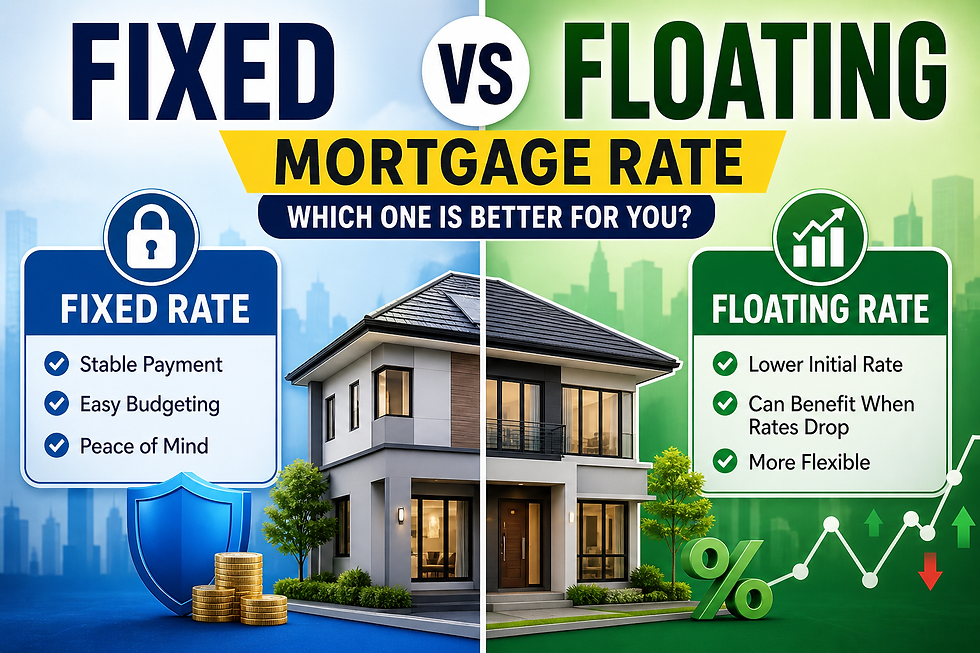
Fixed vs Floating Mortgage Rate Malaysia: Key Differences What Is a Fixed Rate Mortgage?
A fixed rate loan means your interest rate stays the same for a certain period — or sometimes the entire loan tenure.
In Malaysia, fully fixed-rate housing loans are relatively uncommon. Most residential home loans offered by banks are floating-rate facilities linked to the Standardised Base Rate (SBR).
Example:
Loan: RM450,000
Fixed rate: 4.5%
Monthly instalment: stays the same
Even if interest rates go up, your payment does not change
Pros of Fixed Rate
Stable monthly instalment
Easier budgeting
Protection from rising interest rates
Cons of Fixed Rate
Usually higher than floating rates
Less flexibility (early settlement penalties can apply)
You don’t benefit if interest rates drop
What Is a Floating Rate Mortgage?
A floating rate loan (also called variable rate) changes based on the market.
In Malaysia, it is typically tied to:
Bank Negara Malaysia’s Overnight Policy Rate (OPR) = Standardised Base Rate (SBR)
Example:
Rate: SBR + 1.50%
If OPR increases → your instalment increases
If OPR decreases → your instalment decreases
Pros of Floating Rate
Usually lower starting rate
Benefit when interest rates drop
More common and flexible
Cons of Floating Rate
Monthly instalment can increase anytime
Harder to plan long-term
Risk during rising interest cycles
Real Scenario in Malaysia
Let’s say:
Loan: RM450,000
Tenure: 30 years
Scenario 1: Floating Rate (4.3%)
Monthly: ~RM2,227
If OPR increases:
Rate becomes 4.8%
Monthly may increase to ~RM2,361
Scenario 2: Fixed Rate (4.8%)
Monthly: ~RM2,361
Always stays the same
The difference?
Floating starts cheaper — but carries uncertainty.
So… Which One Is Better?
There is no one-size-fits-all answer.
It depends on your situation.
Choose Fixed Rate if you:
Prefer stability and peace of mind
Have tight cash flow
Expect interest rates to rise
Want predictable long-term planning
Choose Floating Rate if you:
Can handle some fluctuation
Want lower initial cost
Expect interest rates to drop
Have strong financial buffer
Most Malaysians choose floating rates — but underestimate the risk.
A small 0.5% increase can significantly affect your cash flow
The real question is:
“Can I still afford my house if my instalment increases by RM200–RM400?”
If the answer is no → fixed rate (or safer loan sizing) may be better.
Common Mistakes to Avoid
Choosing lowest rate without understanding risk
Ignoring future interest rate cycles
Stretching loan to maximum approval
Not having emergency savings
Final Thought
Choosing a mortgage is not just about interest rates.
It’s about:
“How much uncertainty can I handle?”
A slightly higher but stable payment is sometimes better than a cheaper loan that keeps you stressed.


Comments